

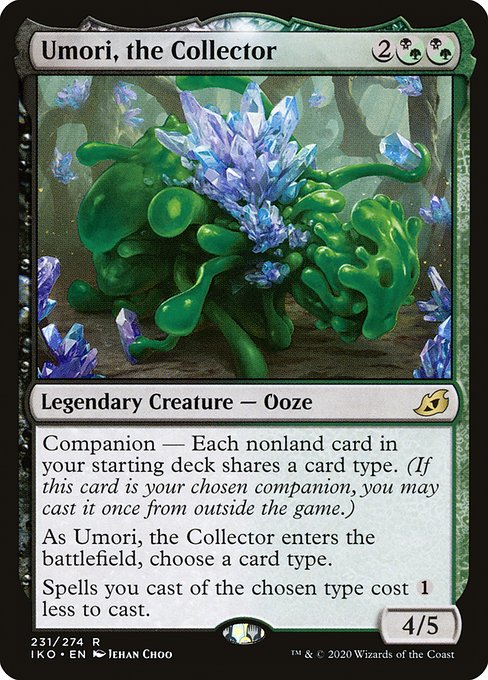
Umori, the Collector
Legendary Creature — Ooze · 4/5
Companion — Each nonland card in your starting deck shares a card type. (If this card is your chosen companion, you may put it into your hand from outside the game for as a sorcery.)
As Umori enters, choose a card type.
Spells you cast of the chosen type cost less to cast.
- CommanderLegal
- StandardNot legal
- PioneerLegal
- ModernLegal
- LegacyLegal
- VintageLegal
- PauperNot legal
Our copies of Umori, the Collector
Selling Umori, the Collector?
Most copies of Umori, the Collector are worth under $1, so we buy them as bulk.
All 8 printings and prices
| Set | # | Released | Nonfoil | Foil | Etched |
|---|---|---|---|---|---|
| Multiverse Legends MUL | 192z | Apr 2023 | – | $199.99 | – |
| Multiverse Legends MUL | 62 | Apr 2023 | $0.32 | $0.43 | – |
| Multiverse Legends MUL | 127 | Apr 2023 | – | – | $0.49 |
| Multiverse Legends MUL | 192 | Apr 2023 | – | $6.02 | – |
| Ikoria: Lair of Behemoths IKO | 358 | Apr 2020 | $0.44 | $0.90 | – |
| Ikoria: Lair of Behemoths Promos PIKO | 231p | Apr 2020 | $0.35 | $1.29 | – |
| Ikoria: Lair of Behemoths IKO | 231 | Apr 2020 | $0.30 | $0.32 | – |
| Ikoria: Lair of Behemoths Promos PIKO | 231s | Apr 2020 | – | $1.00 | – |
TCGplayer market, near mint, Oct 16, 2026.
Rulings
Your companion begins the game outside the game. In tournament play, this means your sideboard. In casual play, it's simply a card you own that's not in your starting deck.
To satisfy Umori's companion requirement, there must be one card type that each nonland card in your starting deck has. For example, if every nonland card is an artifact creature, enchantment creature, or creature, it is satisfied; but if you have an artifact creature, an artifact, and a creature, it is not satisfied.
If more than one player wishes to reveal a companion, the starting player does so first, and players proceed in turn order. Once a player has chosen not to reveal a companion, that player can't change their mind.
The companion's other abilities apply only if the creature is on the battlefield. They have no effect while the companion is outside the game.
Land cards in your deck may have any number of additional types that may be shared with other cards or not.
Effects that reduce the generic mana cost of a spell (such as that of Umori) can't reduce that spell's colored mana requirements.
The companion ability has no effect if the card is in your starting deck and creates no restriction on putting a card with a companion ability into your starting deck. For example, Zirda may be in your starting deck even if your other permanent cards don't all have activated abilities.
You may have one companion in the Commander variant. Your deck, including your commander, must meet its companion requirement. Your companion is not one of your one hundred cards.
Before shuffling your deck to become your library, you may reveal one card from outside the game to be your companion if your starting deck meets the requirements of the companion ability. You can't reveal more than one. It remains revealed outside the game as the game begins.
Paying to put your companion into your hand is a special action. It doesn't use the stack and players can't respond to it. Once you take this action, you may cast that card if it's legal to do so before any other player can take actions.
Artifact, creature, enchantment, instant, planeswalker, and sorcery are card types. Supertypes (such as legendary) and subtypes (such as Ooze) are not.
The requirements of the companion ability apply only to your starting deck. They do not apply to your sideboard.
If you reveal a companion outside the game, for as long as it remains there, you may pay any time you could cast a sorcery (that is, you have priority during your main phase and the stack is empty). Once you do, you put it into your hand and behaves like any other card you've brought into the game. For example, if it's discard, countered, or destroyed, it's put into your graveyard, remaining in the game. This is a change from previous rules.
Paying to put your companion into your hand is a special action. It doesn't use the stack and players can't respond to it. Once you take this action, you may cast that card if it's legal to do so before any other player can take actions.
Once you put your companion into your hand, it behaves like any other card you’ve brought into the game. For example, if it’s countered or destroyed, it’s put into your graveyard, remaining in the game.
Card text, images and rulings from Scryfall. Magic: The Gathering and its card names, text and art are property of Wizards of the Coast.