

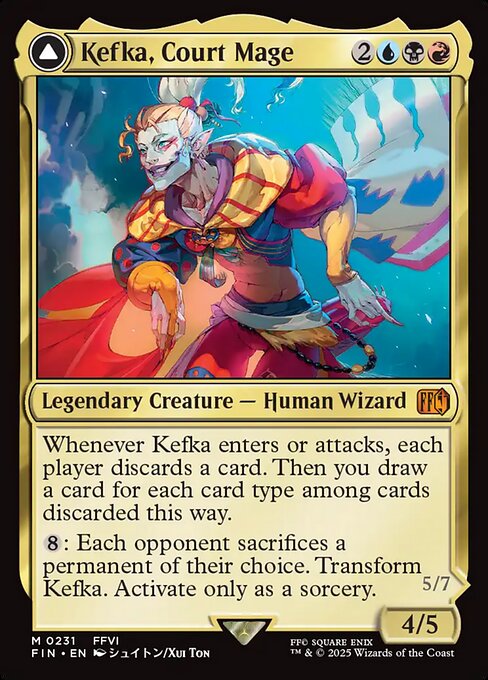
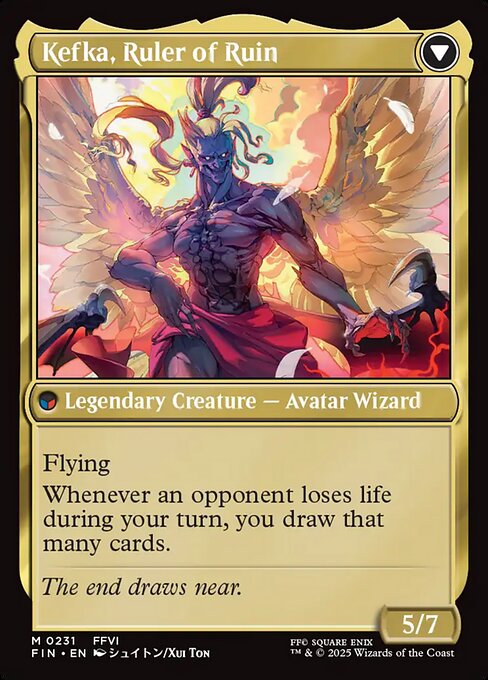
Kefka, Court Mage // Kefka, Ruler of Ruin
Legendary Creature — Human Wizard // Legendary Creature — Avatar Wizard · 4/5
Kefka, Court Mage: Whenever Kefka enters or attacks, each player discards a card. Then you draw a card for each card type among cards discarded this way.
: Each opponent sacrifices a permanent of their choice. Transform Kefka. Activate only as a sorcery.
Kefka, Ruler of Ruin: Flying
Whenever an opponent loses life during your turn, you draw that many cards.
- CommanderLegal
- StandardLegal
- PioneerLegal
- ModernLegal
- LegacyLegal
- VintageLegal
- PauperNot legal
Selling Kefka, Court Mage // Kefka, Ruler of Ruin?
We pay 50% of a card's market value in cash, or 70% in store credit, for cards worth more than $1. For the cheapest printing of Kefka, Court Mage // Kefka, Ruler of Ruin, that's about $2.94 cash or $4.12 in credit.
All 6 printings and prices
| Set | # | Released | Nonfoil | Foil |
|---|---|---|---|---|
| Final Fantasy FIN | 496 | Jun 2025 | $15.00 | $36.96 |
| Final Fantasy FIN | 322 | Jun 2025 | $40.36 | $91.90 |
| Final Fantasy FIN | 543 | Jun 2025 | – | $170.69 |
| Final Fantasy Promos PFIN | 231s | Jun 2025 | – | $29.88 |
| Final Fantasy FIN | 398 | Jun 2025 | $17.83 | $26.79 |
| Final Fantasy FIN | 231 | Jun 2025 | $5.88 | $9.68 |
TCGplayer market, near mint, Oct 16, 2026.
Removal we have in stock




Rulings
Each face of a nonmodal double-faced card has its own set of characteristics: name, types, subtypes, abilities, and so on. While a nonmodal double-faced permanent is on the battlefield, consider only the characteristics of the face that's currently up. The other set of characteristics is ignored.
A nonmodal double-faced card enters with its front face up by default, unless a spell or ability instructs you to put it onto the battlefield transformed or allows you to cast it transformed, in which case it enters with its back face up.
Each nonmodal double-faced card in this release is cast face up. In every zone other than the battlefield, consider only the characteristics of its front face. If it is on the battlefield, consider only the characteristics of the face that's up; the other face's characteristics are ignored.
The back face of a nonmodal double-faced card usually has a color indicator that defines its color.
The card types in Magic include artifact, battle, creature, enchantment, instant, kindred, land, planeswalker, and sorcery. Legendary, basic, and snow are supertypes, not card types; Hero and Saga are subtypes, not card types.
A token that is created as a copy of a double-faced permanent or a double-faced card in another zone is a double-faced token. It will have both the front face and back face of whatever object it's copying. If it's copying a double-faced permanent whose back face is up, the token will enter with its back face up. It can transform if instructed to do so.
While resolving Kefka, Court Mage's last ability, the next opponent in turn order chooses a permanent they control, then each other opponent in turn order does the same. Then each of the chosen permanents are sacrificed simultaneously.
The mana value of a nonmodal double-faced card is the mana value of its front face, no matter which face is up.
In the Commander variant, a double-faced card's color identity is determined by the mana costs and mana symbols in the rules text of both faces combined. If either face has a color indicator or basic land type, those are also considered. For example, Cecil, Dark Knight's color identity is black and white, since its front face is black and its back face has a white color indicator.
If you are instructed to put a card that isn't a double-faced card onto the battlefield transformed, it will not enter at all. In that case, it stays in the zone it was previously in. For example, if a single-faced card is a copy of Crystal Fragments, it will be exiled during the resolution of its second ability and remain in exile.
Card text, images and rulings from Scryfall. Magic: The Gathering and its card names, text and art are property of Wizards of the Coast.