
Getting Started With the Yu-Gi-Oh! Trading Card Game
How a Yu-Gi-Oh! duel works, from summoning and attacking to Spells, Traps and the Extra Deck, plus how to read a card, build a deck and where to play in Provo.
By We Geek Together7 min read
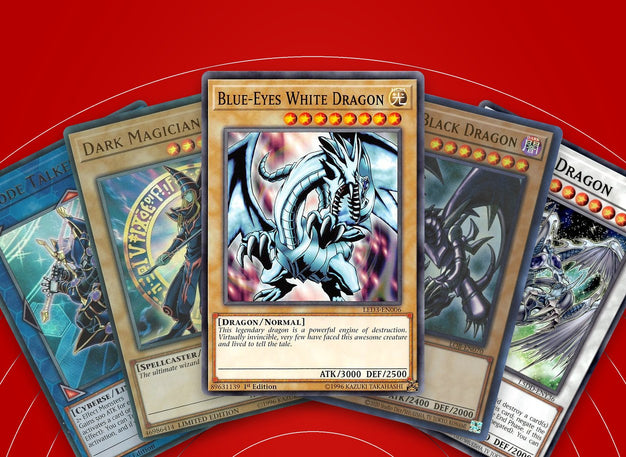
Yu-Gi-Oh! has been around for more than twenty-five years, and it has a reputation for being hard to get into. The basics are simpler than they look, though. You summon monsters, attack with them, and use Spells and Traps to swing the fight. Here's how a duel works, how to read a card, how a deck is put together, and the easiest way to start.
How you win
Each player starts with 8000 Life Points (LP). You win a duel if:
- your opponent's LP drops to 0,
- your opponent has to draw a card and their deck is empty, or
- a card's effect says you win. Exodia the Forbidden One is the famous one.
At tournaments, a match is best two out of three duels.
Your side of the table

- Main Monster Zones: room for five monsters. A monster standing upright is in Attack Position. A monster turned sideways is in Defense Position, and it can be face-down.
- Spell & Trap Zones: room for five Spells and Traps, face-up while they're working or face-down (Set) until you use them.
- Field Zone: one Field Spell, which changes things for both players.
- Extra Monster Zones: two zones in the middle that both players share. You can normally use only one of them. The next section explains what goes there.
- Deck (your Main Deck), Extra Deck and Graveyard (GY). Cards that are destroyed or used go to the Graveyard, face-up.
Your turn
To start, flip a coin or play rock-paper-scissors. The winner picks who goes first. Each player shuffles and draws five cards. There's no mulligan.
Every turn has six phases:
- Draw Phase: draw one card. The player who goes first skips this on the very first turn.
- Standby Phase: some cards do things here. Most turns nothing happens.
- Main Phase 1: summon monsters, play Spells, Set Spells and Traps, and change your monsters' positions.
- Battle Phase: attack with your monsters in Attack Position. The player who goes first can't attack on their first turn.
- Main Phase 2: the same as Main Phase 1, for anything you want to do after combat.
- End Phase: if you have more than six cards in hand, discard down to six.
Summoning monsters
Once per turn you can Normal Summon a monster from your hand face-up in Attack Position, or Set one face-down in Defense Position. It's one or the other, not both. How many stars a monster has (its Level) decides what it costs:
- Level 1 to 4: free.
- Level 5 or 6: you have to Tribute one of your monsters first, by sending it to the Graveyard.
- Level 7 or higher: two Tributes.
That's why Blue-Eyes White Dragon, at Level 8, is hard to get out the normal way. Card effects and the Extra Deck give you other ways. Those are Special Summons, and there's no limit to how many you can do in a turn. Modern Yu-Gi-Oh is mostly about Special Summons.
Attacking
Each monster in Attack Position can attack once in the Battle Phase. If your opponent has no monsters, the attack hits them directly and they lose LP equal to your monster's ATK. If they do have monsters, you have to pick one to attack:
- Against a monster in Attack Position, compare ATK. The lower one is destroyed and its owner loses the difference in LP. If they're equal, both are destroyed.
- Against a monster in Defense Position, compare your ATK to its DEF. If your ATK is higher, it's destroyed, but its owner loses no LP. If its DEF is higher, nothing is destroyed and you lose the difference.
Spells and Traps
Spell cards are mostly played from your hand during your own Main Phase. Some stay on the field (Continuous, Equip and Field Spells), and Quick-Play Spells can be used during either player's turn if you Set them first, though not on the turn you Set them.
Trap cards are the surprise. You have to Set a Trap face-down first, and you can't use it on the turn you Set it. After that you can spring it at the right moment, usually on your opponent's turn.
When one player uses a card, the other can respond with one of their own, and that one can be answered too. This is called a chain, and it resolves from the last card back to the first. You don't need to master chains to play your first games.
Reading a card
Every monster card is laid out the same way. Here's Ash Blossom & Joyous Spring, one of the most-played cards in the game.

The color of the card tells you what kind it is. Orange is an Effect Monster and yellow is a Normal Monster with no effect, just a line of flavor text. Green is a Spell and pink is a Trap. Purple (Fusion), white (Synchro), black (Xyz) and dark blue (Link) are Extra Deck monsters.
The Extra Deck
Some monsters don't go in your Main Deck. They wait in the Extra Deck, and you summon them by combining monsters you already have. That's where most of the game's big plays come from.
- Fusion (purple): use a card like Polymerization and send the monsters listed on the Fusion Monster to the Graveyard.
- Synchro (white): send a Tuner and other monsters from your field to the Graveyard when their Levels add up to the Synchro Monster's Level. Ash Blossom, a Level 3 Tuner, plus a Level 5 monster makes a Level 8 Synchro like Stardust Dragon.
- Xyz (black): stack two or more monsters of the same Level under the Xyz Monster. Xyz Monsters have a Rank instead of a Level, and many of them use the cards stacked underneath to power their effects.
- Link (dark blue): send monsters from your field to the Graveyard, usually as many as the Link Monster's Link Rating. Link Monsters have no DEF and are always in Attack Position. Arrows on the card point to zones next to them.
Fusion, Synchro and Xyz Monsters can go in any of your Main Monster Zones. A Link Monster from your Extra Deck has to go in an Extra Monster Zone or in a zone another of your Link Monsters points to. Pendulum Monsters, the fifth kind, also need those zones when they come from the Extra Deck, but you don't need them to start.
Building a deck
The rules for a deck:
- A Main Deck of 40 to 60 cards. Stay close to 40, so you draw your best cards more often.
- An Extra Deck of up to 15 cards. It doesn't count toward the 40.
- A Side Deck of up to 15 cards, for tournaments. You can swap cards between it and your other decks between duels in a match.
- No more than three copies of any card, across all three decks together.
Some cards have a lower limit. Konami keeps a Forbidden & Limited List: Forbidden cards can't be played at all, Limited cards are one copy, and Semi-Limited cards are two. The list changes a few times a year, so check it before a tournament.
Most decks are built around one archetype, a family of cards with the same name in their titles that are made to work together. Pick one you like the look of and build around it.
Formats
- Advanced is the standard tournament format, using the Forbidden & Limited List. Any card released in the TCG is allowed unless the list says otherwise.
- Genesys is a newer official format. There are no Link or Pendulum Monsters, so there are no Extra Monster Zones either. Instead of the list, some strong cards cost points, and your whole deck has to come in under a cap, usually 100. Most cards cost nothing. It plays more like the game did a few years ago.
- Casual games with friends can use any cards you agree on. The 2-Player Starter Set and Structure Decks are good for this straight out of the box.
Getting cards
- Konami's 2-Player Starter Set is made for brand-new players. It's two ready-to-play decks, each with a 40-card Main Deck and a small Extra Deck, plus a comic book that walks you and a friend through a whole duel step by step, Synchro and Xyz included.
- Structure Decks are the next step. Each one is a complete deck built around one archetype, and two or three copies of the same Structure Deck make a strong deck to start changing. We don't list these online, so ask at the Provo store what's in.
- Booster packs: we have Blazing Dominion booster packs and a booster box. Packs are fun to open, but buying them is a slow way to build a particular deck.
Where to play
Provo, Saturdays: Yu-Gi-Oh locals. Call the Provo store at (801) 477-0426 for the start time.
Check the events page for tournaments. Our other games are in where to play Pokémon, Lorcana and more.
Rules as of November 2026, from Konami's Official Rulebook (Version 10) with the 2021 Rules Update, and the Deck Construction Rules and Genesys pages on yugioh-card.com. Konami updates the Forbidden & Limited List and the Genesys point list regularly.
Yu-Gi-Oh! card images © Kazuki Takahashi / Studio Dice / SHUEISHA, TV TOKYO, KONAMI. We Geek Together is an independent game store and isn't affiliated with Konami.
Keep reading
All stories Board Games
 for Fans of the 2026 Game of the Year Nominees
A tabletop gift for fans of each 2026 Game Awards Game of the Year nominee: GTA VI, Resident Evil Requiem, 007 First Light, Control Resonant, Phantom Blade Zero and Ocarina of Time. All in...
 Guides
Planeswalker: Netflix's Magic: The Gathering Show, and How to Start Playing
What we know about Planeswalker, Netflix's animated Magic: The Gathering series coming in 2027, what a planeswalker is, and the quickest way to start playing the card game in Provo or Sandy.
 Commander
Dune Commanders in Magic: The Eight New Legends
Paul Atreides, Muad'Dib, Chani, the Baron and the other Dune legendary creatures coming to Magic: what's confirmed about each, and how to get a Dune Commander deck ready now.
The singles
Now flip through the whole binder.
7663 cards in stock. Search by name or filter by color, type, format and what the card does.
Browse the singlesMagic: The Gathering, its card images and mana symbols are trademarks and copyrights of Wizards of the Coast LLC. We Geek Together is an independent game store and is not affiliated with Wizards of the Coast.