
Getting Started With Riftbound
How a game of the League of Legends card game works, how to read a card, what goes in a deck, and where to play in Provo and Sandy.
By We Geek Together5 min read
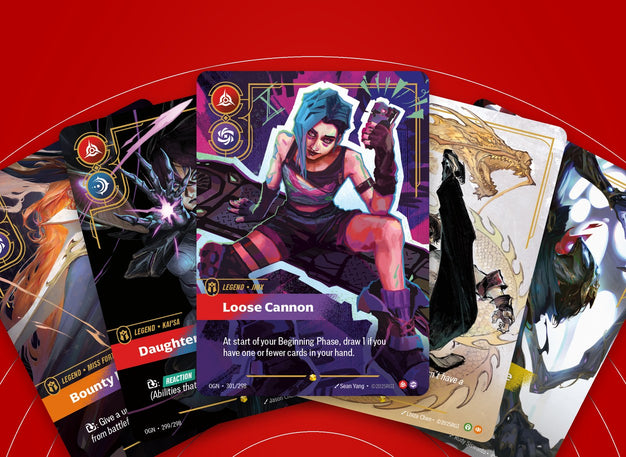
Riftbound is the League of Legends card game from Riot. If you've played League, a lot of it will feel familiar: you pick a champion, send units out to fight over battlefields, and score points for holding them. If you haven't, that's fine too. Here's how a game works, how to read a card, and how a deck is put together.
How you win
Riftbound is played for points, not life. The first player to 8 points wins. You score points by taking and keeping control of the battlefields in the middle of the table.
- Conquer: take control of a battlefield by moving units there. If nobody's there, moving a unit in is enough. If an enemy is there, you have to win a fight first. A conquer is worth 1 point.
- Hold: if you still control a battlefield at the start of your turn, you score it again for 1 point.
You can only score each battlefield once a turn. There's one catch at the end: if a conquer would give you your winning point, you only get it if you've scored every battlefield that turn. Otherwise you draw a card instead. You can still win off a hold.
Your side of the table

A Riftbound deck is really four things:
- Your Champion Legend. It sits in its own zone all game and can't be removed. Its two domains decide which cards your deck can use, and most legends have an ability of their own.
- Your Chosen Champion. A champion unit that matches your legend, like a Jinx unit for a Jinx legend. It starts the game face up in the Champion Zone, so you can always play it, even if you never draw it.
- A Main Deck of 40 cards: your champion, plus units, gear and spells.
- A Rune Deck of 12 runes, shuffled separately. Runes are how you pay for everything.
Each player also brings three battlefields. In a two-player game, one of each player's three goes in the middle, so two battlefields are in play. Units you have that aren't at a battlefield wait in your base, along with your gear.
To start, each player draws 4 cards. You may set aside up to two of them and draw that many replacements, then put the ones you set aside on the bottom of your deck. The player who goes second gets an extra rune on their first turn.
Your turn
Every turn starts the same way:
- Awaken: ready everything you exhausted (turn it upright).
- Beginning: score 1 point for each battlefield you control. This is holding.
- Channel: put the top two runes of your Rune Deck onto the table.
- Draw: draw one card. There's no maximum hand size.
Then, in any order and as often as you can:
- Play cards. To pay the energy cost, exhaust that many runes. To pay a power cost, recycle a rune of the right domain to the bottom of your Rune Deck for each symbol. You can recycle a rune you already exhausted this turn.
- Move units. Exhaust a unit to move it from your base to a battlefield, or back. Units come into play exhausted, so a unit usually can't move on the turn you play it.
- Use abilities on your units, gear and legend.
Moving onto a battlefield where the other player has units starts a combat. First there's a showdown, where both players get a chance to play Action and Reaction cards. Then each side adds up the Might of its units there and deals that much damage to the other side's units. A unit dies once the damage on it reaches its Might. If only your units are left, you conquer the battlefield. When your turn ends, all units heal.
If you ever need to draw and your Main Deck is empty, you burn out. You shuffle your trash back in as your new deck and your opponent gets a point.
Reading a card
Units, gear and spells share the same layout, so once you can read one you can read them all. Here's Jinx, Rebel, a champion unit from Origins.

There are six domains, each with its own color: Fury (red), Calm (green), Mind (blue), Body (orange), Chaos (purple) and Order (yellow). Your legend has two of them, and every card in your deck, your runes included, has to fit inside those two.
Building a deck
The rules for a deck:
- 1 Champion Legend.
- A Main Deck of 40 cards, including a Chosen Champion that matches your legend. Casual games allow more than 40. Tournaments require exactly 40.
- No more than three copies of any card with the same name, and your Chosen Champion counts as one of them. Jinx, Rebel and Jinx, Demolitionist have different names, so you can play three of each.
- No more than three Signature cards in total. These are cards made for one champion, and they have to match your legend.
- 12 runes from your legend's two domains.
- 3 battlefields, each with a different name.
A sensible place to start is a preconstructed deck. It has all of the above and you can play it straight out of the box. Once you've played it a few times, swap in cards one or two at a time. When you split your runes between your two domains, look at how many power symbols of each domain your cards have, and lean toward the one you need more.
Formats
Most games are one on one, to 8 points. Riftbound also has official modes for three players (Skirmish) and four players (War), both free-for-all to 8 points, and a two-on-two team mode played to 11.
For tournaments, Standard uses the current year's sets and the previous year's, with a list of banned cards. In Sealed, you open six booster packs at the event and build from those. For games with friends or at a casual night, any cards are fine as long as everyone agrees.
Getting cards
- The Evelynn vs Seraphine Showdown Deck is the easiest way in. It's two complete, ready-to-play decks with two paper playmats, two booster packs and a rulebook, so you and a friend can learn together.
- Booster packs and boxes are on our Riftbound page.
- Singles are the cheapest way to finish a deck. As we list them, they go on our Riftbound singles page, and here's what the condition labels mean.
Where to play
Sandy, Thursdays, 5 to 8 pm: free Riftbound casual play. This is the night to come in if you're learning.
We also run Pre-Rifts, Riot's name for prereleases, when a new set comes out, and Provo hosts Riftbound tournaments. Check the events page for what's coming up. Our other games are in where to play Pokémon, Lorcana and more.
Rules as of November 2026, from Riot's Core Rules (updated October 9, 2026). Riot updates the rules with each new set.
Riftbound, League of Legends and their card images © Riot Games. We Geek Together is an independent game store and isn't affiliated with Riot Games.
Keep reading
All stories Board Games
 for Fans of the 2026 Game of the Year Nominees
A tabletop gift for fans of each 2026 Game Awards Game of the Year nominee: GTA VI, Resident Evil Requiem, 007 First Light, Control Resonant, Phantom Blade Zero and Ocarina of Time. All in...
 Guides
Planeswalker: Netflix's Magic: The Gathering Show, and How to Start Playing
What we know about Planeswalker, Netflix's animated Magic: The Gathering series coming in 2027, what a planeswalker is, and the quickest way to start playing the card game in Provo or Sandy.
 Commander
Dune Commanders in Magic: The Eight New Legends
Paul Atreides, Muad'Dib, Chani, the Baron and the other Dune legendary creatures coming to Magic: what's confirmed about each, and how to get a Dune Commander deck ready now.
The singles
Now flip through the whole binder.
7663 cards in stock. Search by name or filter by color, type, format and what the card does.
Browse the singlesMagic: The Gathering, its card images and mana symbols are trademarks and copyrights of Wizards of the Coast LLC. We Geek Together is an independent game store and is not affiliated with Wizards of the Coast.